
Using a Computerized Accounting System? You May Be Covered by the New BIR E-Invoicing Rules

Executive Summary
If your business uses a Computerized Accounting System (CAS), Computerized Books of Accounts with electronic invoicing, or other invoicing software, you may already fall within the taxpayers required to comply with the BIR’s electronic invoicing rules.
Under Revenue Regulations No. 11-2025, as amended by RR No. 26-2025, taxpayers using these systems are among those given until December 31, 2026 to comply with the mandatory issuance of electronic invoices.
This does not mean that every invoice generated by a computerized system automatically qualifies as an electronic invoice.
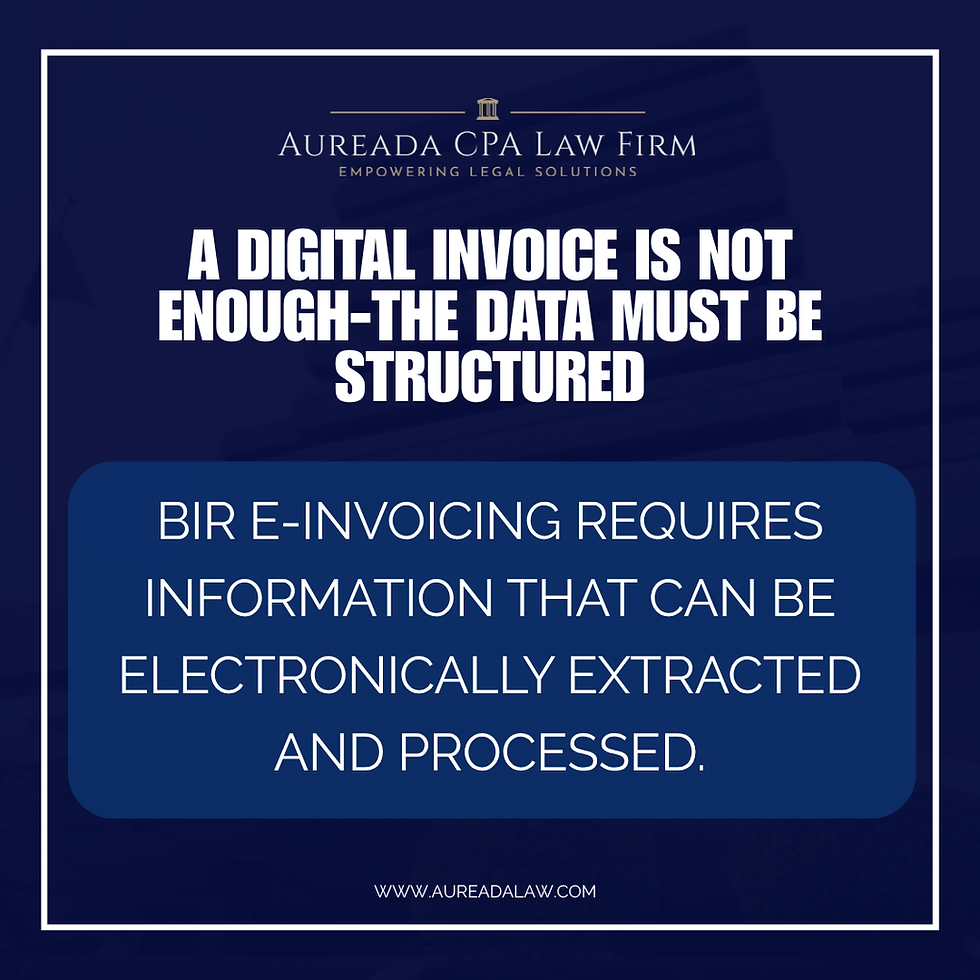
The BIR specifically distinguishes between a true electronic invoice and a system-generated invoice that is simply printed on paper. For an invoice to qualify, the underlying data must be structured, electronically extractable, and capable of supporting electronic transmission and reporting.
For businesses already using CAS, the important question is no longer simply, “Do we use accounting software?” It is: “Can our system actually meet the new BIR e-invoicing requirements?”
Why CAS Users Should Pay Attention to BIR E-Invoicing
A Computerized Accounting System can help a business record transactions, maintain books, generate reports, and issue invoices.
But under the new BIR rules, using a CAS can also place a taxpayer directly within the scope of mandatory electronic invoicing.
RR No. 26-2025 specifically includes taxpayers using:
Computerized Accounting Systems (CAS), Computerized Books of Accounts with Accounting Records with electronic invoicing, and other invoicing software.
Covered taxpayers have until December 31, 2026 to comply with the electronic invoice issuance requirements.
This makes system readiness particularly important for businesses that already rely on ERP platforms, accounting software, customized billing systems, or integrated invoicing solutions.
Does a CAS-Generated Invoice Automatically Qualify as an E-Invoice?
No.
A system-generated invoice is not automatically a BIR electronic invoice.
RR No. 11-2025 explains that invoices generated through CAS, CBA with electronic invoicing, CRM, POS, or other invoicing software and then simply printed for issuance to the buyer do not qualify as electronic invoices if the system is not capable or ready to electronically report the required sales and invoice data.
In that situation, the invoice is treated as a traditional invoice, even though a computer generated it.
This is one of the most important distinctions for businesses to understand.
Computer-generated does not automatically mean electronically compliant.
What Does the BIR Require From a CAS?
The BIR requires covered accounting and invoicing systems to generate invoices using structured invoice data.
This means the information behind the invoice should be organized in a format that can be easily extracted electronically and made ready for transmission to the BIR for electronic sales reporting.
In practical terms, the system should not merely create a visual document.
It should be able to identify and process information such as the invoice number, customer details, transaction date, taxable sales, VAT, discounts, withholding taxes, and total amount as separate electronic data fields.
That is what makes electronic processing possible.
Step-by-Step Guide: Check Whether Your CAS Is Ready
Step 1: Identify the System You Are Currently Using
Start by determining exactly what your business uses for accounting and invoicing.
Is it a registered CAS? An ERP? A customized accounting platform? Computerized Books of Accounts? A separate invoicing application?
Knowing the actual setup is important because the compliance requirements may depend on how the system generates invoices and stores transaction data.
Step 2: Check Whether Your System Generates Structured Invoice Data
Ask whether the system can store invoice details in structured electronic fields.
If the only output is a PDF or printed invoice, your system may need further review.
A compliant setup should be capable of electronically extracting the invoice information rather than relying on someone to manually read or re-enter the data.
Step 3: Check How Invoices Are Issued
If the business generates invoices through CAS but only prints and physically hands them to customers, that process does not automatically satisfy the electronic invoicing requirement.
The system must support the required electronic invoicing functionality.
Businesses should therefore review both how the invoice is created and how it is issued.
Step 4: Review Whether the Current CAS Needs Reconfiguration
Some businesses may not need an entirely new accounting system.
Their existing CAS may only require reconfiguration, additional modules, middleware, or updates to make invoice information electronically extractable and compatible with the BIR’s requirements.
RR No. 26-2025 expressly recognizes that taxpayers may need time for system reconfiguration and transition to electronic invoicing, which is one reason the deadline was extended to December 31, 2026.
Step 5: Review BIR Registration and Approval Requirements
Businesses should also review whether changes to their CAS or invoicing component require an update to their existing BIR registration or approval.
The BIR continues to maintain procedures for applications involving authority to use Computerized Accounting Systems and related components.
Before implementing major changes, businesses should determine whether the proposed modification affects the system that was originally registered with the BIR.
Step 6: Test Before the December 31, 2026 Deadline
Do not wait until December to determine whether the system works.
Businesses should test invoice generation, required invoice fields, VAT treatment, customer information, electronic delivery, data extraction, and system compatibility early.
Tax, accounting, IT, and software providers may all need to work together.
Electronic Invoicing vs. Electronic Sales Reporting
Businesses should also understand that electronic invoice issuance and electronic sales reporting are related but distinct requirements.
RR No. 11-2025 requires covered taxpayers to issue electronic invoices containing structured data that can be electronically extracted and made ready for BIR reporting.
The BIR's Electronic Invoicing and Sales Reporting System also has a separate certification framework for transmitting required sales data.
Businesses should therefore avoid assuming that generating an electronic invoice automatically means every sales-reporting requirement has already been completed.
Risks and Penalties
Failing to prepare the CAS for electronic invoicing can create both compliance and operational problems.
A business may discover too late that its accounting system generates invoices but cannot produce the required structured data.
This can lead to rushed software upgrades, additional implementation costs, delayed approvals, and errors in invoice generation.
Non-compliance may also expose covered taxpayers to applicable BIR penalties under the Tax Code and related regulations.
There is an additional audit risk: if invoice data cannot be properly reconciled with accounting records, tax returns, and future sales reporting, inconsistencies may become easier to identify during a BIR review.
Practical Examples
Example 1: CAS Generates Invoices but Only Prints Them
ABC Corporation uses a registered CAS.
The system generates invoices automatically, but employees print the invoices and provide paper copies to customers. The system is not configured to electronically extract or transmit the required invoice information.
Under the BIR rules, those invoices do not automatically qualify as electronic invoices simply because they were generated by CAS.
Example 2: ERP With Structured Invoice Data
XYZ Corporation uses an ERP system that separately stores invoice number, customer information, taxable sales, VAT, and transaction totals.
The system can electronically export the data and generate invoices for electronic issuance.
This setup is much closer to the system functionality contemplated by the BIR e-invoicing rules, subject to applicable registration, approval, and technical requirements.
Example 3: Existing CAS Needs an Upgrade
DEF Corporation has used the same computerized accounting system for several years.
Its software can create invoices and accounting reports, but it cannot produce structured invoice data in a format that can be electronically processed.
The company may need to work with its software provider to update or reconfigure the system before the December 31, 2026 deadline.
Frequently Asked Questions
Are all CAS users covered by the December 31, 2026 deadline?
RR No. 26-2025 expressly includes taxpayers using CAS, CBA with Accounting Records with electronic invoicing, and other invoicing software among the taxpayers given until December 31, 2026 to comply with electronic invoice issuance requirements.
Businesses should review their specific setup to determine how the rule applies.
Is an invoice generated by CAS already an electronic invoice?
Not necessarily.
If the invoice is simply system-generated and printed, without the required capability for electronic data extraction and reporting readiness, it is treated as a traditional invoice rather than a qualifying electronic invoice.
Do we need to replace our existing CAS?
Not always.
Some systems may only need configuration changes, upgrades, additional modules, or integration work.
The answer depends on the technical capabilities of the existing system.
What is structured invoice data?
It is invoice information organized in a predictable, machine-readable format that can be electronically extracted and processed.
The BIR requires this because electronic invoicing is intended to support automated electronic processing and reporting.
Is December 31, 2026 the deadline?
Yes. RR No. 26-2025 gives covered taxpayers, including the identified CAS and invoicing-system users, until December 31, 2026 to comply with the electronic invoice issuance requirements.
Should businesses wait until December to update their system?
No.
System assessment, development, reconfiguration, testing, BIR compliance review, and employee training can take time.
December 31 should be treated as the deadline to be compliant not the date to begin the project.
Related Articles
For internal linking, this article can connect to:
BIR E-Invoicing Deadline December 31, 2026: Is Your Business Covered?
Is a PDF Invoice an Electronic Invoice? What BIR RMC No. 98-2026 Actually Requires
Why Word, Excel, Google Docs, and Google Sheets Do Not Qualify as BIR E-Invoices
What Is Structured Invoice Data and Why Does the BIR Require It?
Electronic Invoicing vs. Electronic Sales Reporting: What Businesses Need to Know
Review Your CAS Before the Deadline
Using a computerized accounting system does not automatically mean your business is ready for BIR electronic invoicing.
The critical question is whether your system can generate structured electronic invoice data, support electronic issuance, and meet the applicable BIR requirements.
For businesses already using CAS, ERP, CBA, or invoicing software, the transition may involve upgrading or reconfiguring an existing system rather than starting from scratch.
With the December 31, 2026 deadline approaching, now is the time to identify gaps and begin testing.
Need assistance reviewing whether your Computerized Accounting System is ready for BIR e-invoicing?
Aureada CPA Law Firm can assist businesses with CAS registration and updates, electronic invoicing compliance, BIR requirements, and related tax and regulatory matters.

Comments