
What Is Structured Invoice Data and Why Does the BIR Require It? A Simple Guide for Businesses

Executive Summary
As the Philippines moves toward mandatory electronic invoicing, businesses are hearing a new term more often: structured invoice data.
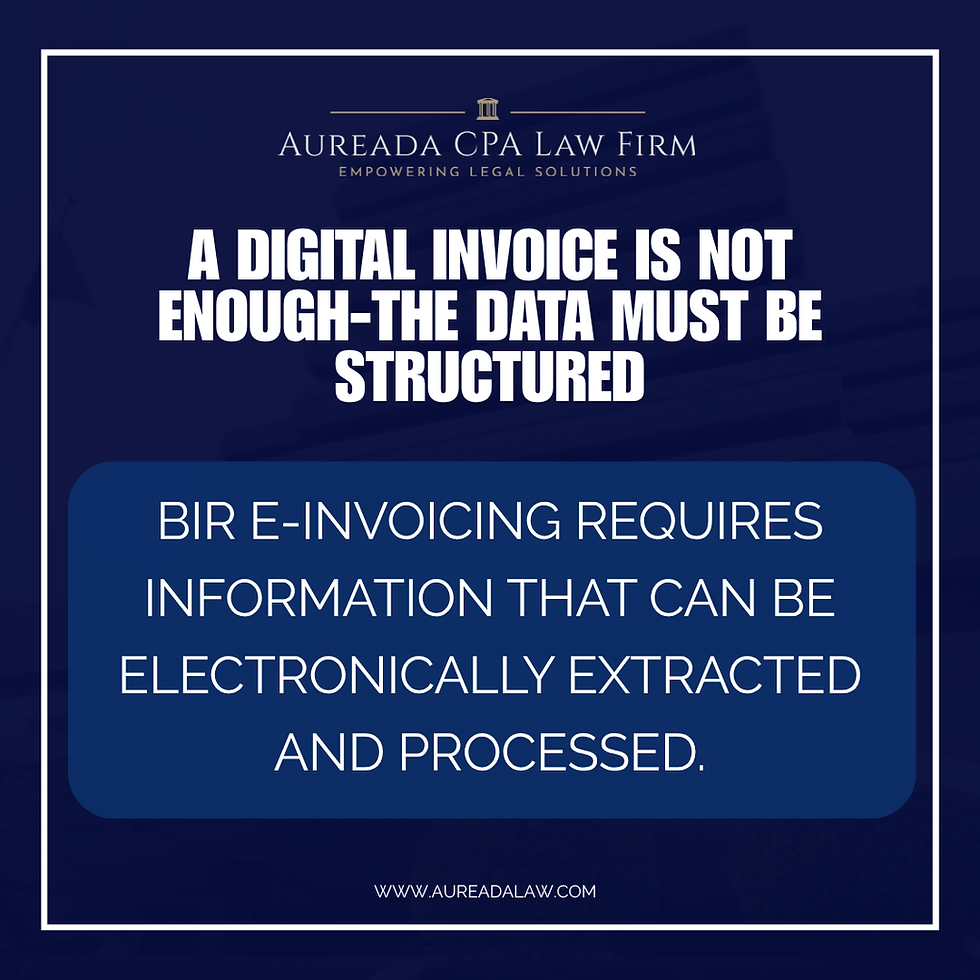
In simple terms, structured invoice data means invoice information arranged in a consistent, machine-readable format so a computer can automatically identify, process, and transmit the data.
This is different from a PDF, scanned invoice, or image file. Those documents may be easy for people to read, but the information inside them is not necessarily organized in a way that systems can automatically process.
Under BIR Revenue Memorandum Circular No. 98-2026, electronic invoices must use a structured electronic format. The BIR's existing Electronic Invoicing System uses JSON, or JavaScript Object Notation, for transmitting sales data. Businesses may use other structured formats internally, provided the required information can be converted into the BIR-prescribed format.
For covered taxpayers preparing for the December 31, 2026 e-invoicing deadline, understanding structured data is important because it affects whether an invoicing system can meet BIR requirements.
What Is Structured Invoice Data?
Think of a traditional invoice as a document designed mainly for a person to read.
You may see:
Invoice No.: 000123Date: October 6, 2026Customer: ABC Corporation VAT: ₱1,200Total: ₱11,200
A person can easily understand that information.
Structured data goes one step further. Each piece of information is stored in a predictable field that tells a computer exactly what it represents.
The system does not have to "look" at the invoice and guess which number is the VAT amount or which text is the customer name. Those values are already organized in clearly defined data fields.
RMC No. 98-2026 describes structured electronic information as data organized in a set and predictable way so that computers can readily read, sort, and use it.
Why Does the BIR Require Structured Data?
The main reason is automation.
Electronic invoicing is intended to allow invoice information to move from one system to another without repeatedly retyping the same data.
Under the BIR framework, an electronic invoice must contain structured invoice information that can be easily extracted electronically and made ready for transmission for electronic sales reporting.
Structured data can therefore make it easier to validate transactions, process large volumes of invoice information, reconcile sales records, and eventually transmit required information directly to the BIR.
This is also why electronic sales reporting is designed around system-to-system data transfer without manual entry, rather than sending PDF or image copies of invoices.
Structured Data vs. PDF: What Is the Difference?
This is one of the easiest ways to understand the requirement.
A PDF invoice is primarily a visual document. It shows the customer what was sold, the amount due, VAT, and other details.
Structured invoice data is the information behind or associated with that invoice in a format that software can automatically process.
A PDF can still be provided to a customer as part of an electronic invoicing setup. But the PDF itself is not what makes the invoice compliant.
What matters is whether the underlying system generates the required information in structured form and whether that data can be electronically extracted and processed.
Step-by-Step Guide: How to Check Whether Your Invoice Data Is Structured
Step 1: Look at How Your Invoices Are Generated
Start with your current invoicing process.
If employees manually type invoice information into Word, Excel, Google Docs, or Google Sheets, you are generally creating a digital document rather than structured electronic invoice data.
By contrast, accounting software, ERP systems, CAS, POS platforms, or dedicated invoicing solutions may store each invoice element as separate data fields.
Step 2: Ask Whether the System Stores Individual Data Fields
A structured system should be able to identify invoice details separately.
For example, it should know which value is the invoice number, transaction date, seller information, customer information, taxable sales, VAT, discount, and total amount.
These details should not exist only as text displayed on a page.
Step 3: Check Whether the Data Can Be Exported
Ask your software provider or IT team:
Can invoice information be exported electronically in a structured format?
If the only available output is a PDF or image, the system may require modification.
If the system can produce formats such as JSON or another machine-readable structured format, it may be better positioned for BIR e-invoicing compliance.
Step 4: Check Whether the Data Can Be Converted to the BIR Format
RMC No. 98-2026 does not necessarily require every business to use JSON as its internal invoice format.
A business may continue using another structured format internally, provided the required sales data can be converted and transmitted in the format prescribed by the BIR.
This means businesses should focus on data compatibility, not merely file extensions.
Step 5: Test the Entire Process
Do not check only whether your software can generate a nice-looking invoice.
Test whether the underlying data can actually be extracted, mapped, processed, and eventually transmitted without manually re-entering every transaction.
That is the practical difference between document digitization and true electronic invoicing.
Why Does the BIR Use JSON?
The BIR's existing Electronic Invoicing System uses JSON, short for JavaScript Object Notation, for the transmission of sales data.
Despite the technical name, the concept is straightforward.
JSON organizes information into clear labels and values that computers can understand.
For example, instead of a system merely displaying:
Total: ₱11,200
the electronic record can identify that number specifically as the invoice's total amount.
This makes automated processing possible without requiring someone to manually read and re-enter the information.
Risks of Using Unstructured Invoice Data
Businesses that rely solely on PDF files, manually prepared spreadsheets, or other unstructured documents may encounter problems when transitioning to BIR e-invoicing.
They may discover that their current accounting system cannot extract the required information automatically.
This can result in additional software development, data mapping, system upgrades, testing, and implementation costs.
For covered taxpayers, waiting until late 2026 to identify these gaps may also increase the risk of missing the compliance deadline.
RR No. 26-2025 gives specified covered taxpayers until December 31, 2026 to comply with electronic invoice issuance requirements, including taxpayers using certain computerized accounting and invoicing systems.
Practical Examples
Example 1: Invoice Created in Word
ABC Consulting manually types an invoice in Microsoft Word and saves it as PDF.
The customer can read the invoice, but the computer does not necessarily have separate structured fields identifying the invoice number, VAT, taxable sales, and total.
This is a digital document, but it does not by itself satisfy the structured-data requirement.
Example 2: Excel Invoice Template
XYZ Trading uses an Excel template with formulas for VAT and totals.
Although Excel can organize information into cells, manually preparing invoices through an office productivity application does not automatically make the result a BIR-compliant electronic invoice.
The business still needs a compliant invoicing process that generates structured electronic invoice information capable of extraction and processing.
Example 3: Accounting Software
DEF Corporation uses accounting software that automatically records each transaction.
When an invoice is generated, the system separately stores the invoice number, date, buyer information, sales amount, tax details, and total.
If the system can export or convert this information into the structured format required by the BIR, it is much closer to the type of system contemplated by the e-invoicing rules.
Frequently Asked Questions
Is structured data the same as an electronic invoice?
Not exactly.
Structured data is one of the key characteristics required for an electronic invoice. The invoice must also satisfy the other applicable BIR requirements, including system generation and electronic issuance.
Is a PDF considered structured invoice data?
Not by itself.
A PDF is primarily a document format. The underlying invoice information must be available in structured, machine-readable form for electronic processing.
Does the BIR require JSON?
The BIR's existing Electronic Invoicing System prescribes JSON for sales-data transmission.
However, taxpayers may use other structured formats internally if the required data can be converted into the BIR-prescribed format.
What does "machine-readable" mean?
It means software can automatically identify and process each piece of information without someone manually reading the invoice and typing the data again.
Does Excel count as structured data?
Excel can technically store information in organized fields, but using Excel to manually prepare invoices does not automatically satisfy the BIR's electronic invoicing requirements.
Businesses must consider the entire invoicing system and whether it meets the structured-data, electronic issuance, and processing requirements.
Why is structured invoice data important for electronic sales reporting?
Electronic sales reporting is intended to transfer invoice information directly between systems without manual re-entry.
Structured data makes that automated transmission possible.
Prepare Your Invoice Data, Not Just Your Invoice Design
BIR e-invoicing is not simply about changing a paper invoice into a digital file.
The bigger change is happening behind the document.
Structured invoice data allows information to be automatically read, processed, extracted, and eventually transmitted between systems. That is why businesses preparing for electronic invoicing should review not only what their invoices look like, but also how their accounting systems create and store the underlying data.
With the December 31, 2026 compliance deadline approaching for covered taxpayers, businesses should start identifying system and data gaps early.
Need assistance assessing whether your accounting or invoicing system is ready for BIR e-invoicing?
Aureada CPA Law Firm can assist businesses with BIR electronic invoicing compliance, computerized accounting system reviews, tax registration requirements, and related regulatory matters.


Comments