
Myth vs. Fact: Can Any BIR Officer Audit Your Business in the Philippines?
- Yasser Aureada
- 1 day ago
- 5 min read
Executive Summary
Myth: Any BIR officer can walk into your business and conduct a tax audit.
Fact: A BIR tax audit generally requires proper legal authority. A revenue officer performing assessment functions must be validly authorized to examine the taxpayer’s books and records pursuant to a Letter of Authority or LOA. Section 13 of the Tax Code expressly provides that a revenue officer may examine taxpayers pursuant to an LOA issued by the proper authority.
The Supreme Court has repeatedly emphasized that the authority of the revenue officer matters. If the person actually conducting the examination is not properly authorized, the validity of the resulting assessment may be affected.
For business owners, this means you should cooperate with legitimate BIR processes but you should also verify the authority, scope, and officers assigned to the audit.
Myth: Any BIR Officer Can Audit Your Business
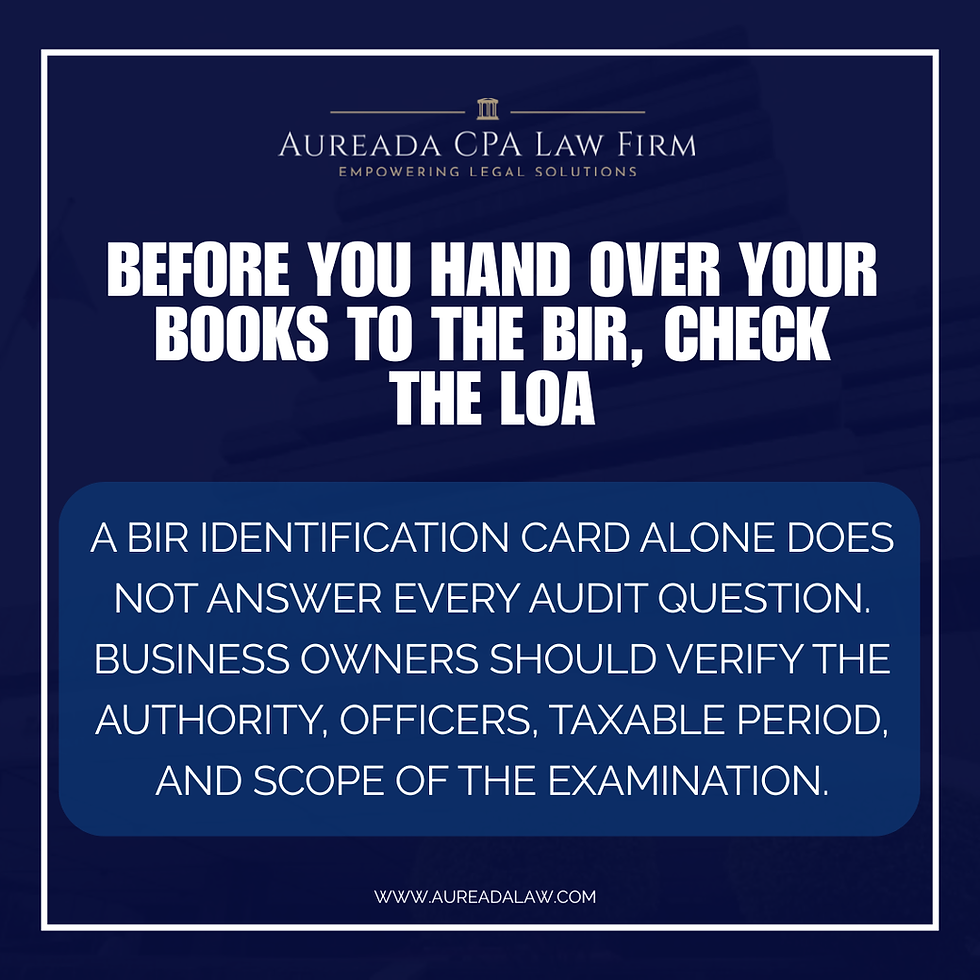
Not every BIR employee automatically has authority to examine your books of accounts and other accounting records.
The Tax Code gives assessment powers to revenue officers who are properly assigned and authorized. An audit is therefore not simply based on an officer’s position or identification as a BIR employee.
The Letter of Authority is an important part of this process.
Fact: A Valid Letter of Authority Matters
A Letter of Authority is more than a routine administrative document.
The Supreme Court has described an LOA as the authority that enables the appropriate revenue officer to examine a taxpayer’s books and accounting records for the purpose of determining the correct amount of tax.
A valid LOA helps the taxpayer identify the authorized examination and understand who is permitted to conduct it.
This requirement also protects taxpayers from unauthorized or irregular examinations.
What Should You Check in a BIR Letter of Authority?
When your business receives an LOA, review it carefully before turning over records.
Check whether it correctly identifies the taxpayer, the taxable period or periods being examined, and the revenue officers assigned to the audit.
The Supreme Court has stressed that identifying the authorized revenue officers is an important requirement of a valid BIR examination.
If the person requesting your records is different from the officer identified in the authority, the situation should be reviewed carefully.
Myth: Another BIR Officer Can Simply Take Over the Audit
Fact: Reassignment is not necessarily that simple.
In Commissioner of Internal Revenue v. McDonald’s Philippines Realty Corp., the Supreme Court ruled that replacing the revenue officers originally named in the LOA with other officers without the required authority violates the taxpayer’s right to due process and BIR audit rules.
The Court explained that an LOA is not a general authority available to any revenue officer. It is a special authorization connected to the officers tasked with conducting the examination.
Similarly, in another case, the Supreme Court held that an officer who conducted the audit based only on a memorandum of assignment, without the necessary new LOA, lacked authority to conduct the examination.
Why Does the Officer’s Authority Matter?
Tax audits involve access to sensitive business information.
Revenue officers may request books of accounts, invoices, tax returns, contracts, schedules, ledgers, and other records relevant to determining whether the correct taxes were reported.
Because these powers are significant, the government must follow the procedures established by law.
The Supreme Court has held that lack of proper authority can affect the validity of the assessment arising from the audit.
This is why the LOA should never be treated as a mere formality.
What Should a Business Owner Do When a BIR Officer Arrives?
Do not automatically refuse to cooperate.
Instead, verify the audit properly.
Ask to see the relevant authority and identification. Compare the officers conducting the examination with the officers identified in the LOA. Check the taxable period and scope of the audit before providing records.
If something does not match, document the discrepancy and seek professional advice before making conclusions about the validity of the examination.
The objective is not to obstruct a legitimate audit. It is to make sure the examination follows the proper legal process.
Myth: If the LOA Has a Problem, You Can Ignore the BIR
Fact: Never simply ignore official BIR communications.
Questions involving the validity of an LOA or the authority of a revenue officer should be raised through the proper legal and administrative process.
Ignoring notices, refusing all communication, or withholding records without understanding the legal basis can create additional complications.
A better approach is to preserve the documents, review the authority, respond within applicable deadlines, and raise procedural objections properly when necessary.
Practical Example
Suppose an LOA identifies Revenue Officer A as the person authorized to examine your company’s records.
Several weeks later, Revenue Officer B appears and begins requesting documents, explaining that the case was reassigned internally.
The business should not automatically assume that Officer B has the same audit authority.
Supreme Court decisions have held that internal memoranda or reassignment documents do not necessarily substitute for the authorization required for a revenue officer who was not properly authorized under the LOA.
The company should verify the legal authority for the change before proceeding.
Common Mistakes Business Owners Make During a BIR Audit
One mistake is assuming that every person from the BIR has automatic authority to examine company records.
Another is immediately providing large volumes of documents without reviewing the LOA and determining the scope of the examination.
Businesses may also overlook changes in the revenue officers handling the audit.
On the other hand, automatically refusing to cooperate simply because you suspect a procedural problem can also be risky.
The safer approach is to verify first, document carefully, and respond through the proper process.
BIR Audit Authorization Checklist
Before allowing an examination to proceed, review:
Taxpayer identified → Letter of Authority → authorized revenue officers → taxable period → type and scope of examination → officers actually conducting the audit → documents requested → deadlines → records of all submissions and communications.
If the actual audit process does not match the authority presented, consider obtaining legal and tax advice promptly.
Frequently Asked Questions
Can any BIR employee ask to examine my books?
Not automatically. A revenue officer conducting an assessment examination must have the authority required under the Tax Code and applicable BIR procedures.
What is the purpose of a Letter of Authority?
An LOA authorizes the examination of the taxpayer and identifies the revenue officers permitted to perform the audit. The Supreme Court has emphasized its importance to the legality of the audit and resulting assessment.
What if a different revenue officer conducts the audit?
This should be reviewed carefully. Supreme Court cases have invalidated assessments where an unauthorized replacement officer conducted the examination without the required authority.
Does an invalid LOA automatically mean I should ignore the audit?
No. Any objection regarding authority should be handled properly and within the applicable procedural deadlines. Seek professional advice rather than simply refusing communication.
Should I ask the BIR officer for identification?
Yes. Verifying the identity of the officers involved and comparing them with the relevant authority is a reasonable compliance step during an audit.
Final Thoughts
Myth: Any BIR officer can audit your business.
Fact: A legitimate BIR examination requires proper authority.
The Letter of Authority is important because it establishes that the examination has been authorized and identifies the revenue officers permitted to conduct the audit.
For business owners, the best approach is neither blind compliance nor automatic refusal.
Check the LOA. Verify the officers. Understand the taxable period. Review the scope. Keep records of every submission.
Knowing these basic steps can help protect your business while still cooperating with lawful BIR procedures.
Need Assistance With a BIR Audit or Letter of Authority?
Aureada CPA Law Firm can assist businesses in reviewing BIR Letters of Authority, audit notices, document requests, assessments, and related tax controversy matters.


Comments